Where in the world is Luther? It's a city without a single motor car or bicycle. It sank about nine inches and the sea level is rising. Gondolas are everywhere and the bus from the airport is a boat.

If you guessed Athens or anything besides Venice, you're wrong. I haven't talked about Athens yet. Therefore it must be Venice. Below is a picture outside our Bed and Breakfast. The canal is blocked off for construction on the adjacent building. That's the orange thing on the right bottom corner and the boat is filled with construction supplies under a tarp. Yes, there's caution men working even in water canals.
We had one full day of getting lost in the side streets. Our bed and breakfast is on the far side of St. Marc's Square. That's a good thing considering the amount of people filling the square and side streets from the cruise ships. A city three decades ago held 160,000 people but has shrunk to 60,000. The cost of living here and no jobs outside of tourism means you move. (Luther felt at home as some side streets were four to six feet wide. He could shimmy up and over the four story buildings. Walking around you might come across a huge church or façade that looks like something out of the 1700-1800's. (Luther said, "The city started around 1000 AD and most of what you see has been built since 1500 to the 1800's." I said, "Oh.")
 Lo
Lo
(Luther was relieved there were many side streets that weren't flooded. I told him the canals were actually streets for boats. He thought that was weird and said, "Whatever floats your boat." He didn't like dragging his suitcase over the rough rock streets. "This is a real drag!")
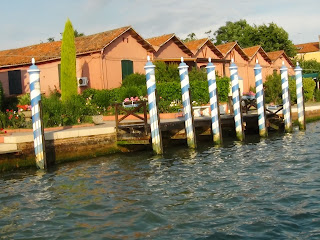
Check out the lollipop style boat bumpers. There are two factions of people in competition. Those who want to cater to tourism and those who want their city to be a place of art. So they end up with a combination of both and split resources. Maybe that's not so bad.

A tucked out of the way restaurant between buildings near its own small square is just what the stomach ordered.

But the main square is where the tourist action is happening. It's the
Piazza San Marco is the main square of Venice. Not pictured here by the way, look down 2 pictures below. I really don't remember where the one to the right was taken. The one below is a square in Venice but not the famous one where St. Peter's Basilica and the Doge palace, bell tower and so on are located.

Inside the courtyard of Doge's palace where still today you'll find administration offices in use while the original ones have become a museum.
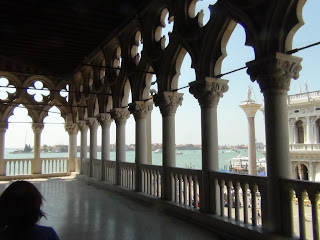
We are looking over the balcony of the Doge's palace out into the sea over the Piazza San Marco Square entrance. This is where towering cruise ships port and thousands suddenly swarm the square. It's best to get there early to get tickets before the cruise ships.

The scenic side canals run throughout the city as well as normal walking streets. This is one of the bridges to cross when walking from the Piazza San Marco square across town to the Archeology Museum.
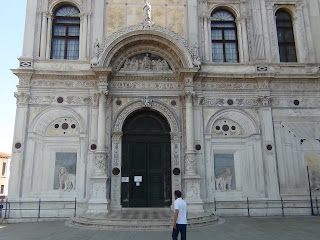
You never know when you walk down a narrow street what might pop out at the next square. Here is a church façade in marble. The lions on both sides of the doors within the huge doors are three dimensional. They pop out while the hallway scene behind them give the illusion of a hallway. This picture does not do it justice.
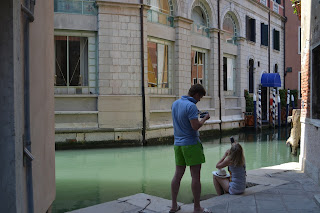
Sometimes you have to wait for the bus. Like these people. But for people like us, we'd rather walk across the small city. You can walk from end to end in less than an hour, providing you can find the bridges and the right narrow passageways that always curve. A compass would have been handy.
S
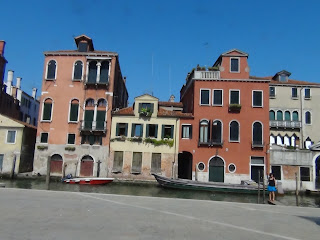
Homes and apartments were for sale. Anywhere from 40,000 Euros to over a million. Lots were for sale as the town numbers dwindle. It makes me think of a great retirement home (apartment). Think about it.

Here we are in the main floor of our Bed and Breakfast. It's dark an the floor is stone. Above are the apartments. This is where you might store your boats once upon a time. The doors in front of Megan are not for walking. There are steps that go down to your boat when the tide is out. Otherwise you need to go across the 2x4 when the tide is up.

The tide is in and the boys could not resist walking out on the board. I didn't think it was for walking until the locals were using it to get to their motorboat. Looked like fun to me. There was some sort of crab-like creature on one of the steps.
On the opposite side of Piazza San Marco square are many places to eat on the water. They look across to a walled palace still in use.

We were in Doge's palace, the seat of power during the lucrative spice trade flowing out of India into Europe. Part of that palace was a wing of prisons. After a court found a person guilty and sentenced them to prison, they would walk through a small passageway over a cannel in a covered bridge aptly named, "The Bridge of Sighs." We were in a line with hundreds of other people making our way towards the prison cells. Luther and I were in front of a priest giving his teenage group a tour. "Father, where are we going?" He explained in English why the bridge got its name. Immediately they all began giving him big sighs. He exclaimed, "Guys, we're not even on the bridge yet." You have to love youth groups. Below is a hole into a prison cell where you might receive water or watched. On the left is the prison courtyard where you can see a well for water. But if you are one of the hundreds of prisoners you might have to wait to get some.

Even the hearses for funerals and the ambulances are boats! Didn't the get the picture though.

It seems the rich in the big Italian cities had no problem getting statures from the Roman Empire's ruins and setting them up in their own palaces.
The palace, the art museum, terrific architecture visited by the multitudes makes the entire island of buildings one gigantic museum. (Luther wasn't so sure. Something smelled fishy with the sea in the canals filled with greenish smoky water, a far cry from the Mediterranean sea off the coast of Naxos. For some reason he didn't want to swim.) Although the city is in decline, there's something beautiful about it.
The wrinkles of age tell many fascinating stories.


 My sister Cindy and me (Melissa)


 If you guessed Athens or anything besides Venice, you're wrong. I haven't talked about Athens yet. Therefore it must be Venice. Below is a picture outside our Bed and Breakfast. The canal is blocked off for construction on the adjacent building. That's the orange thing on the right bottom corner and the boat is filled with construction supplies under a tarp. Yes, there's caution men working even in water canals.

 A tucked out of the way restaurant between buildings near its own small square is just what the stomach ordered.
  But the main square is where the tourist action is happening. It's the Piazza San Marco is the main square of Venice. Not pictured here by the way, look down 2 pictures below. I really don't remember where the one to the right was taken. The one below is a square in Venice but not the famous one where St. Peter's Basilica and the Doge palace, bell tower and so on are located.


 Here we are in the main floor of our Bed and Breakfast. It's dark an the floor is stone. Above are the apartments. This is where you might store your boats once upon a time. The doors in front of Megan are not for walking. There are steps that go down to your boat when the tide is out. Otherwise you need to go across the 2x4 when the tide is up.

 We were in Doge's palace, the seat of power during the lucrative spice trade flowing out of India into Europe. Part of that palace was a wing of prisons. After a court found a person guilty and sentenced them to prison, they would walk through a small passageway over a cannel in a covered bridge aptly named, "The Bridge of Sighs." We were in a line with hundreds of other people making our way towards the prison cells. Luther and I were in front of a priest giving his teenage group a tour. "Father, where are we going?" He explained in English why the bridge got its name. Immediately they all began giving him big sighs. He exclaimed, "Guys, we're not even on the bridge yet." You have to love youth groups. Below is a hole into a prison cell where you might receive water or watched. On the left is the prison courtyard where you can see a well for water. But if you are one of the hundreds of prisoners you might have to wait to get some.
 It seems the rich in the big Italian cities had no problem getting statures from the Roman Empire's ruins and setting them up in their own palaces.


