
Sunday, June 30, 2013


Venice in its glory!
Wow, I can't stop taking pictures! Venice is so beautiful, every corner, every street is delightful. Our first day, we did not run into many tourist. These pictures are from June 23rd.



Sunday, June 23, 2013
Where in the world is Luther? It's a city without a single motor car or bicycle. It sank about nine inches and the sea level is rising. Gondolas are everywhere and the bus from the airport is a boat.
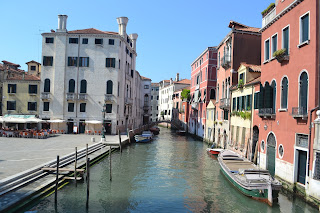
 If you guessed Athens or anything besides Venice, you're wrong. I haven't talked about Athens yet. Therefore it must be Venice. Below is a picture outside our Bed and Breakfast. The canal is blocked off for construction on the adjacent building. That's the orange thing on the right bottom corner and the boat is filled with construction supplies under a tarp. Yes, there's caution men working even in water canals.
We had one full day of getting lost in the side streets. Our bed and breakfast is on the far side of St. Marc's Square. That's a good thing considering the amount of people filling the square and side streets from the cruise ships. A city three decades ago held 160,000 people but has shrunk to 60,000. The cost of living here and no jobs outside of tourism means you move. (Luther felt at home as some side streets were four to six feet wide. He could shimmy up and over the four story buildings. Walking around you might come across a huge church or façade that looks like something out of the 1700-1800's. (Luther said, "The city started around 1000 AD and most of what you see has been built since 1500 to the 1800's." I said, "Oh.")

Lo
(Luther was relieved there were many side streets that weren't flooded. I told him the canals were actually streets for boats. He thought that was weird and said, "Whatever floats your boat." He didn't like dragging his suitcase over the rough rock streets. "This is a real drag!")
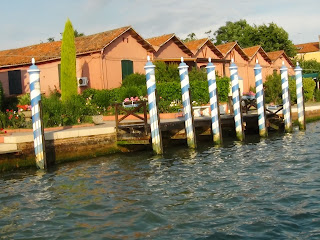
Check out the lollipop style boat bumpers. There are two factions of people in competition. Those who want to cater to tourism and those who want their city to be a place of art. So they end up with a combination of both and split resources. Maybe that's not so bad.
 A tucked out of the way restaurant between buildings near its own small square is just what the stomach ordered.
 But the main square is where the tourist action is happening. It's the Piazza San Marco is the main square of Venice. Not pictured here by the way, look down 2 pictures below. I really don't remember where the one to the right was taken. The one below is a square in Venice but not the famous one where St. Peter's Basilica and the Doge palace, bell tower and so on are located.


Inside the courtyard of Doge's palace where still today you'll find administration offices in use while the original ones have become a museum.
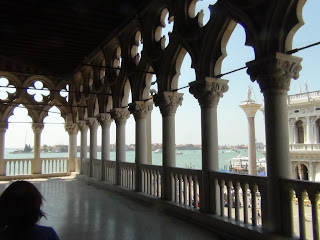
We are looking over the balcony of the Doge's palace out into the sea over the Piazza San Marco Square entrance. This is where towering cruise ships port and thousands suddenly swarm the square. It's best to get there early to get tickets before the cruise ships.

The scenic side canals run throughout the city as well as normal walking streets. This is one of the bridges to cross when walking from the Piazza San Marco square across town to the Archeology Museum.
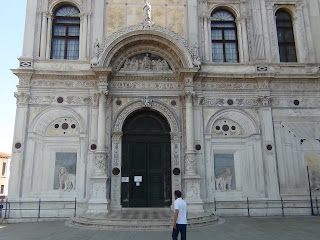
You never know when you walk down a narrow street what might pop out at the next square. Here is a church façade in marble. The lions on both sides of the doors within the huge doors are three dimensional. They pop out while the hallway scene behind them give the illusion of a hallway. This picture does not do it justice.
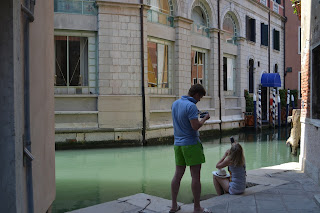
Sometimes you have to wait for the bus. Like these people. But for people like us, we'd rather walk across the small city. You can walk from end to end in less than an hour, providing you can find the bridges and the right narrow passageways that always curve. A compass would have been handy.
S
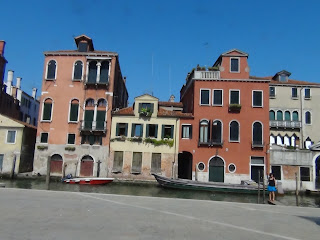
Homes and apartments were for sale. Anywhere from 40,000 Euros to over a million. Lots were for sale as the town numbers dwindle. It makes me think of a great retirement home (apartment). Think about it.
 Here we are in the main floor of our Bed and Breakfast. It's dark an the floor is stone. Above are the apartments. This is where you might store your boats once upon a time. The doors in front of Megan are not for walking. There are steps that go down to your boat when the tide is out. Otherwise you need to go across the 2x4 when the tide is up.

The tide is in and the boys could not resist walking out on the board. I didn't think it was for walking until the locals were using it to get to their motorboat. Looked like fun to me. There was some sort of crab-like creature on one of the steps.
 On the opposite side of Piazza San Marco square are many places to eat on the water. They look across to a walled palace still in use.
 We were in Doge's palace, the seat of power during the lucrative spice trade flowing out of India into Europe. Part of that palace was a wing of prisons. After a court found a person guilty and sentenced them to prison, they would walk through a small passageway over a cannel in a covered bridge aptly named, "The Bridge of Sighs." We were in a line with hundreds of other people making our way towards the prison cells. Luther and I were in front of a priest giving his teenage group a tour. "Father, where are we going?" He explained in English why the bridge got its name. Immediately they all began giving him big sighs. He exclaimed, "Guys, we're not even on the bridge yet." You have to love youth groups. Below is a hole into a prison cell where you might receive water or watched. On the left is the prison courtyard where you can see a well for water. But if you are one of the hundreds of prisoners you might have to wait to get some.

Even the hearses for funerals and the ambulances are boats! Didn't the get the picture though.
 It seems the rich in the big Italian cities had no problem getting statures from the Roman Empire's ruins and setting them up in their own palaces.
The palace, the art museum, terrific architecture visited by the multitudes makes the entire island of buildings one gigantic museum. (Luther wasn't so sure. Something smelled fishy with the sea in the canals filled with greenish smoky water, a far cry from the Mediterranean sea off the coast of Naxos. For some reason he didn't want to swim.) Although the city is in decline, there's something beautiful about it.
It seems the rich in the big Italian cities had no problem getting statures from the Roman Empire's ruins and setting them up in their own palaces.
The palace, the art museum, terrific architecture visited by the multitudes makes the entire island of buildings one gigantic museum. (Luther wasn't so sure. Something smelled fishy with the sea in the canals filled with greenish smoky water, a far cry from the Mediterranean sea off the coast of Naxos. For some reason he didn't want to swim.) Although the city is in decline, there's something beautiful about it.
The wrinkles of age tell many fascinating stories.
 If you guessed Athens or anything besides Venice, you're wrong. I haven't talked about Athens yet. Therefore it must be Venice. Below is a picture outside our Bed and Breakfast. The canal is blocked off for construction on the adjacent building. That's the orange thing on the right bottom corner and the boat is filled with construction supplies under a tarp. Yes, there's caution men working even in water canals.
We had one full day of getting lost in the side streets. Our bed and breakfast is on the far side of St. Marc's Square. That's a good thing considering the amount of people filling the square and side streets from the cruise ships. A city three decades ago held 160,000 people but has shrunk to 60,000. The cost of living here and no jobs outside of tourism means you move. (Luther felt at home as some side streets were four to six feet wide. He could shimmy up and over the four story buildings. Walking around you might come across a huge church or façade that looks like something out of the 1700-1800's. (Luther said, "The city started around 1000 AD and most of what you see has been built since 1500 to the 1800's." I said, "Oh.")

Lo
(Luther was relieved there were many side streets that weren't flooded. I told him the canals were actually streets for boats. He thought that was weird and said, "Whatever floats your boat." He didn't like dragging his suitcase over the rough rock streets. "This is a real drag!")

Check out the lollipop style boat bumpers. There are two factions of people in competition. Those who want to cater to tourism and those who want their city to be a place of art. So they end up with a combination of both and split resources. Maybe that's not so bad.
 A tucked out of the way restaurant between buildings near its own small square is just what the stomach ordered.
  But the main square is where the tourist action is happening. It's the Piazza San Marco is the main square of Venice. Not pictured here by the way, look down 2 pictures below. I really don't remember where the one to the right was taken. The one below is a square in Venice but not the famous one where St. Peter's Basilica and the Doge palace, bell tower and so on are located.


Inside the courtyard of Doge's palace where still today you'll find administration offices in use while the original ones have become a museum.


We are looking over the balcony of the Doge's palace out into the sea over the Piazza San Marco Square entrance. This is where towering cruise ships port and thousands suddenly swarm the square. It's best to get there early to get tickets before the cruise ships.

The scenic side canals run throughout the city as well as normal walking streets. This is one of the bridges to cross when walking from the Piazza San Marco square across town to the Archeology Museum.

You never know when you walk down a narrow street what might pop out at the next square. Here is a church façade in marble. The lions on both sides of the doors within the huge doors are three dimensional. They pop out while the hallway scene behind them give the illusion of a hallway. This picture does not do it justice.

Sometimes you have to wait for the bus. Like these people. But for people like us, we'd rather walk across the small city. You can walk from end to end in less than an hour, providing you can find the bridges and the right narrow passageways that always curve. A compass would have been handy.
S

Homes and apartments were for sale. Anywhere from 40,000 Euros to over a million. Lots were for sale as the town numbers dwindle. It makes me think of a great retirement home (apartment). Think about it.
 Here we are in the main floor of our Bed and Breakfast. It's dark an the floor is stone. Above are the apartments. This is where you might store your boats once upon a time. The doors in front of Megan are not for walking. There are steps that go down to your boat when the tide is out. Otherwise you need to go across the 2x4 when the tide is up.

The tide is in and the boys could not resist walking out on the board. I didn't think it was for walking until the locals were using it to get to their motorboat. Looked like fun to me. There was some sort of crab-like creature on one of the steps.

 We were in Doge's palace, the seat of power during the lucrative spice trade flowing out of India into Europe. Part of that palace was a wing of prisons. After a court found a person guilty and sentenced them to prison, they would walk through a small passageway over a cannel in a covered bridge aptly named, "The Bridge of Sighs." We were in a line with hundreds of other people making our way towards the prison cells. Luther and I were in front of a priest giving his teenage group a tour. "Father, where are we going?" He explained in English why the bridge got its name. Immediately they all began giving him big sighs. He exclaimed, "Guys, we're not even on the bridge yet." You have to love youth groups. Below is a hole into a prison cell where you might receive water or watched. On the left is the prison courtyard where you can see a well for water. But if you are one of the hundreds of prisoners you might have to wait to get some.
Even the hearses for funerals and the ambulances are boats! Didn't the get the picture though.
 It seems the rich in the big Italian cities had no problem getting statures from the Roman Empire's ruins and setting them up in their own palaces.
The wrinkles of age tell many fascinating stories.
Friday, June 21, 2013
Taking every wrong turn wasn't so bad after all
Where in the world is Luther? He’s in the dark in more than
one way. He’s driven batty by high pitched squeaks. It took some bouldering to
get there.
If you guessed Zeus cave on Naxos Island, you’re correct. (I asked if Luther noticed that they spell it wrong in all their publications, "How embarrassing for the Greeks to spell Zeus as Zas." Luther slapped his furry forehead.)
I was hoping to find an ATM at the airport but came to find
out that my house is bigger than the airport. I’m quite certain the lady that
checks in bags, tells the two ground crew dudes with the ping pong paddles to
wave in the plane and get the luggage, calls the local police to run the ex-ray machine for the
next travelers, must also run up to the second story to be the air traffic
controller. She was doing it all. The two brutes that pulled off our luggage a
few feet away wouldn’t let us get them. We needed to walk off the fairway between
two small buildings. There we found ourselves in a parking lot. On the other
side of the small two story building was a single car garage with the label “Baggage
Claim” above the door. Inside the five foot conveyer belt brought in our luggage
from the same guys we saw moments ago a few feet from the turbo prop. Apparently
they like to use their conveyer belt. And yet in the crowd of twenty people we managed to leave a suitcase behind.
A taxi took us to our house where the car rental place would
drop off our car. The one straight and lonely road by the airport had a traffic
light but no intersection. That’s when I realized when it turns red you better
stop or you might get the roof of your vehicle taken off by some landing gear.
No joke. I loved every second of that airport experience.
(Luther got a chuckle out of the guy from England who asked
my how the rugby team in Australia was doing. I explained I didn’t know much
about rugby as I was an American. He said, “We’ll you look big enough to play.”)
Part of the fun on Naxos Island is the tension in the car
between the driver and the navigator. In the United States one would find
signs, many of them clearly marking where to turn and mark the site once you
are there. But Naxos is a rural Island of about 18,000 people. The largest
city, Hora, has about 5000. Life is a slower pace with few people. They figure
you can’t get lost for long so you don't really need signs.
Near the beach the numbers swell in the summer as
tourists come to town on the slow and high speed ferries. (I told Luther I once
rode one. He wondered how fast it went and how many cars it could hold. I told
him I didn’t see any cars. All I did was jump on the fairy, heard a pitiful
squeak and went nowhere except to brush off a lot of pixy dust from my seat.
Luther didn’t think that was funny.)
Anyhow, with maps that have little detail
and roads that don’t go straight. Some intersections are T’s and Y’s with no
clear understanding of which road is the main one. And as in many other places
people come for food and water fun, not rocks that ancient people once used.
There was little competition for parking space at the historical sites.
Do not be fooled by newer asphalt on the main road. It may turn
onto a side road to continue paving. One would have the impression that it’s
the main road but no, the bumpy one that looks like a turn off was really the
main road. Either the street pavers took the wrong turn or they just love
messing with tourists. Some intersections have five to seven roads to choose. Once
we found the turn to Zeus’s cave [Where the Greek mythology said he was hidden
away from the Titans as a baby to grow up and defeat the Titans. Of course
there are a few Zeus caves on various Islands but Naxos is the one most commonly
cited in Mythology books.] we discovered our one lane road was a two way after
all. After some heart stopping moments and my navigator sucked in air in fear
more than once while the driver concentrated more than defeating a monster in
Zelda.
When we found the cave it went far back and was pitch black.
It always seemed foggy unless you were moving fast. After a few minutes I lifted
an arm in front of my head lamp. My limbs were steaming as if on fire. (Luther
was grossed out.) The sweat from the hot sun steamed off into the cool black. We
went as far as the main cave would go up and down very rocky terrain with tar
like coatings. (Luther was mortified to find out it was most likely from
centuries of goat droppings.) Holes, some of them big enough to crawl into
showed signs of people visiting from the early 1900’s onward. Although many
think scratching your name on a cave wall is wrong, I loved seeing the names
and dates. It was a cool end to a hike up the mountain.
Next stop was the marble city, filled with buildings made of
many different kinds of, yep you guessed it, marble. We found delicious dances
on our taste buds from a local café. Their gyros hit the spot like no other
dish.
On our way back I wanted to stop at the temple to Demeter. Be
clear as to where you are going as apparently there were some temple envy going
on in the ancient times as well as you might find two temples to Demeter on
opposite sides of the Island. That makes asking for directions to a temple a
bit tricky. A road sign may have the name of the town or place with an arrow
but it may not be clear as to which one of the 3 or four roads it points. Oh,
and the real fun signs are the ones that are posted in only one direction. You
have to drive past it for miles to realize you missed the turn and then go back
to see a clear sign. Just for kicks and giggles you go past it to come from the
other way and yep, you guessed it, no sign. You just have to know where things
are. Either they don’t bother to post signs or lots of bedrooms have big signs
hung on their walls. And when you do find the impressive ruins of a temple on
some side road that farmers use, there’s a surprise over the hill, tucked away
and surrounded by trees. Most stumble upon it because attached are the places people
look for such as “WC” or “Toilet.” Even then the museum was closed. It was Monday.
Rats. (Luther said, “Bugger,” which reminded him he could do his monkey grooming
and find some protein snacks.)
Again we find an
ancient sacred spot that most likely housed a wooden temple, or open air space.
Then a marble temple would be constructed by the Greeks. As the culture changes
and Rome becomes Christianized, the temple gets converted into a church. After
that the Ottoman (Turks) put their stamp on it. Centuries of changes make for
interesting history and wonderment at the original building to its many
modifications. Which one would you restore?
Since this site never became a city, many of the marble
stones for the Temple can be found in nearby structures or half buried in the
ground. As they are found and not in use in another structure to be preserved,
they are replaced using strict guidelines so that parts are rebuilt. It is
illegal across Europe to completely restore a ruined building.
This temple to Demeter was built in the 500s BCE. It was the
first use inside columns of different heights to hold a pitched marble roof.
Most temples were made either flat stone roofs with a pitched wooden and tiled
roof or an all wood roof.
We took a tour of part of a castle built in about the 1200
AD. The family still lives there. (Luther went straight for the old cellar
where one could sample local drinks.) The castle museum showed a kitchen with a
deep cistern for water and enjoyed seeing an outdoor Turkish style potty with a
view of the bay—spectacular place to go.
An archeological museum is filled with pottery and figuring’s
that farmers constantly turn up from their fields. One piece seemed to be an
ancient souvenir from Egypt. As expected there are lots of marble sculptures
and burial reliefs. In ancient times Naxos was known for their wine, emery and
marble. They would cut the stone within a couple of inches for a statue, send
it to another city somewhere in Greece where the sculpture would finish it. A
marble boy stature was abandoned after the transporters broke its leg. (Luther
thought they could have used super glue. I told him they didn't invent that yet but who knows what would have
happened if the Roman Empire didn’t fall. By the 300s AD they had all the elements
needed to make a steam engine from the piston and valves to the wheel and crank
shaft about 1600 years before the first steam engine. They were already using water wheels to run stone cutters. When I turned around
to see if Luther understood, he was gone, silly monkey.)"Ma's Ditty to Apollo"
Where in the world is Luther? It was the most renowned temple to Apollo in the ancient world next to Delphi. How many
workers per mason and how much did they get paid to build a column? Was the
temple ever finished? The city’s name sounds like, “your ma’s favorite ditty.”
If you guessed Didyma, you guessed right. Above the modern town stands the Temple to Apollo. (Luther said it didn’t look at all like the Apollo
program he’d seen.)
Do you see the people on the bottom left? The steps were big!


We drove but the ancients traveled a 17 km road loaded with way stations and statues of members of the Branchidae family. They ran the temple. (Luther asked why that family got to run it and get all the offerings? I told him they claimed to be descendants of Branchidae, a favorite youth that Apollo loved. Luther said, “So?” I said, “Well it worked for them.”) [As is most of the cool stuff in Turkey and Greece, you have to go to the British Museum in London to see them. Many of the statues are there.] In 600 BC a smaller temple to Apollo existed built upon a spring. A small temple of wood probably existed first before a small stone temple built to house a stature of Apollo. A priestess would be seated above the spring and gave people utterances. But the spring dried up in the 600s BCE and the oracle tradition stopped. (Luther asked if she had a bad case of dry mouth without that spring water.) The temple was still used until the Persians, destroyed it in 494 BCE. After the Persians were driven out by Alexander the Great, he found the spring flowing again and so set up a new priesthood to restore the temple. Seleucus I Nictator, (Luther asked, "Are you sure it's not Seleucus the dictator?" I said, "Google doesn't lie." Luther said, "Oh, brother.") he brought the bronze-age cult practice back to the temple. The people from Miletus began the construction of the new building, [The ruins we now see] It would have been the largest Greek and Roman temple ever built if it would have been completed. We know because a German archeologist found a 200 square foot blue print scratched on rocks left on the far wall of the adyton, the inner court wall.

It took 380 pounds of silver per column because each of the
20,000 workers received 8.6 grams of silver. Although it is not comparable, it’s
fun to try. So you take 8.6 grams times 20,000 workers to get 172,000 grams of
silver. Divide it by 28 ounces per gram would equal about 6,143 ounces. The
price per ounce today is around 22 dollars. That would mean about 135,000
dollars per column. 120 columns were planned. That’s 16,217142 million dollars
without counting walls, floors and other major masonry, quarrying costs and transport. If we knew how much 8.6
grams of silver bought a person, we could come close to knowing how much in
today’s dollars.. (Luther said, “Sufficient to say it cost a lot. Impressive for a
bunch of hairless apes.” I think he was jealous.)
"Paul Was Here"

Although people lived there since about 3500 BCE, the Greek town of Priene was founded in about 350 BCE. It was located on a sea coast at the foot of Mount Mycale. It never grew to more than 4-5,000 inhabitants. They were once known as luxurious intellectuals. Heraclitus railed against their wealthy living. There's always a critic.
("Hey, Luther, get down from there, can't your read the sign?" Luther responded, "It's all Greek to me!" I said, "Read the pink lettering, that's English." Luther said, "Hang on, I will after I go out on a limb.")

As often is the case, we walk on a street that would be littered on each side by housing before reaching the town's center where the temples, administrative buildings, fountains and theaters would be located, the lotus of activity. Most ruins are only partially excavated, most is still rubble under years of silt. It takes time and money to learn about our past. This city moved every couple of centuries and so the original city center hasn't been discovered. Farmers are reluctant to let people dig through their crops.
So, why pick this place to build a Greek City?
.JPG)
Roman built their usual public baths and other buildings before the town became a village as it's two ports were silted over. Most probably moved to Miletus (a city down the coast) so you get a real picture of a Greek city that wasn't built over much after the Roman times.
On the right is one of the many fountain pools for people or animals. These dot the streets. On the left thank you Wikipedia maps for the location of Miletus. The orange dot is on the Western coast of modern Turkey.
.JPG)

The next thing you need to do is build a beautiful temple dedicated to a particular god. The hope is that god will be pleased and visit the city with its blessing. [Modern business people might say that's a self fulfilling prophecy because something beautiful attracts visitors and their money. That in turn provides jobs and blesses a community with riches. Human reality doesn't change as the visitor center still takes in money to see these things. As far as fountains go Rome, Athens and many cities still have sidewalk fountains where people stop to get water. And religion's side affect still provides jobs (yours truly), a community and commence.]
 On your left is what remains of the Temple to Athena. There are many foundations of other temples and a Jewish Synagogue.
 .JPG)
The theater was used for plays, discussions and before each production, a sacrifice. Note the cracked altar below. Also where our children are seated were the stone chairs for honored people of the town. This Greek amphitheater was small compared to the Roman and I'd guess reworked by the Romans. The trees grew in after the theater fell into ruin by the march of time.
 Luther got the dirt on this town.
Due to deforestation around 1000 BCE and poor soil
management by small farmers, dirt washed from the hills into the sea. Miles of
the Aegean Sea were filled up. This town and the other major cities eventually lost access to the
sea and therefore trade. That ended the riches and caused the cities to be
abandoned. The picture [that
will eventually accompany this] shows countless farm squares in the valley.
Imagine that ground being many meters deep of sea in 1000 BCE.

Priene was the greatest (not in size) and wealthiest Greek city from 600-500 BCE.
What marks a wealthy town? A third of the houses had indoor plumbing as opposed to the normal use of public baths and bathrooms.

The Pinnacle of Prosperous and Pristine People
Where in the world is Luther? Now you see, Luther can’t see the sea. It’s built not on your Cale but Mycale. There’s always a critic. Fans of Alexander the Great and Mausolus live here.
(Luther wanted to see how big the
gods Zeus, Demeter and Athenia temples
were. “What about their eyebrows and foreheads. If their temples are that big
their head must be huge.”)
Priene of Ionia was founded in 350 BCE on the Aegean Sea
cost built into the steps of a mountain, Mycale. (Luther pointed out that there
are many steps to this mountain, whew. Couldn’t they have built the city closer
to the valley?) It grew to only about 4,000-5,000 people, never becoming a
politically powerful city. Yet its square (bouleuterion) for the city council of citizens, the executive office building (prytaneion),
a theater (theater), and commercial shop area (agora) are easily found. Like most
Greek and Roman cities there are many memorials from stone markers to elaborate
fountains and of course, baths. (Luther asked if the Greeks and Romans were
really dirty people. I told him the baths were meant for getting together to
talk and cool off or warm up depending on the season. Luther wondered what they
did during the pepper and salt season. I dropped him off at a tree.) (Luther got into trouble and had to find me. Why did he get into trouble?)


The city required households to make daily visits to the various fountains. That visit became another task for the slaves. (Luther wondered if slaves were like being an animal in a zoo behind bars. I told him being a slave to a household meant you worked for your master and were paid room and board. Luther thought working for a room would be okay but he didn’t like the bored part.)
A recorded comment from a critic, Heraclitus, railed against
its citizens for their decadence and luxurious living from sea trades. One
third of the homes had indoor plumbing. (Luther liked Heraclitus and began to be
like him by criticizing me. “You’re eating too much.” “Hurry up.” “You spend
too much time watching rocks.”)
Springs and an aqueduct kept the water flowing through the
city. We traveled from city gate to city gate, following the ancient road
through. This is where the stone foundations show where the wooden doors once
hung and the chariot grooves cut into the marble.
By 100 BCE they lost their port to the open sea and by 2nd
century AD all port access were lost and with it their wealth. By 300 AD only Lake Bafa existed and the city was abandoned and the people moved to Miletus miles away because they still had a port. [Look in the background of the picture. That was once water, not land in 1000 BCE]


We enjoyed the theater as it was
well preserved including chairs for the powerful and the altar for sacrifices
before a performance. (Luther like the fact that the forest over took the ruins
giving us plenty of shade. He asked what kind of animal was sacrificed at the
theater. I told him only the critical furry ones that ask too many questions.
He looked worried for a second.)
(Luther playing with Carson on the sacrificial altar.)

(Luther playing with Carson on the sacrificial altar.)

Subscribe to:
Posts (Atom)